Restricting freedoms to ensure them
A framework for political discussions

Almost all of our choices and actions (or inactions) have a cost to other people, directly or indirectly.
The only role of a government is to restrict our freedom to take (or not take) actions that would, have a cost to, or reduce the freedoms or autonomy of others.
How we determine what a government should restrict, depends on the relative weighting of the action: i.e., the impact on the action-taker vs. the impact on others.
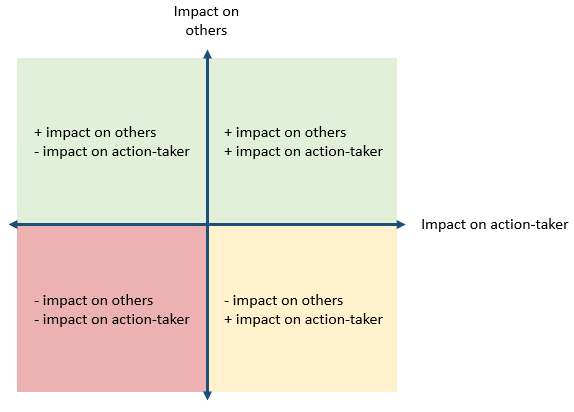
We can theoretically plot any specific actions on a table like the following to think about the relative impact.
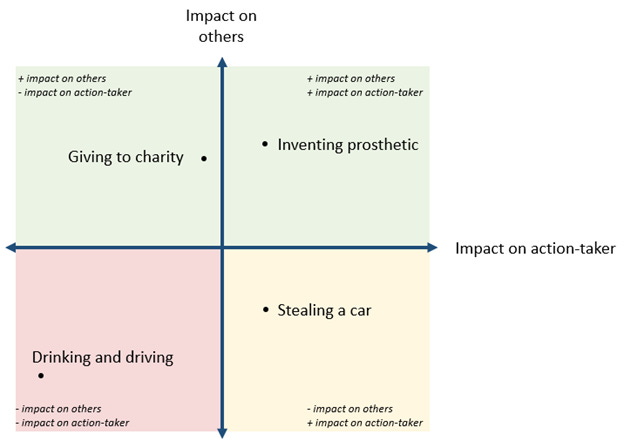
There are direct and easy-to-plot examples:
Giving to charity
Inventing an improved prosthetic device
Stealing a car
Driving intoxicated (potential outcomes)
There are also many actions (inactions) that have indirect impacts on others:
Not wearing a seatbelt
Potential cost to others: increased insurance premiums, hospital capacity, mental health impact to family members that lose you, therapy costs for the people that see you fly through a window, etc., etc.
Traveling to another country without specific vaccinations
Potential cost to others: introducing a virus that the local population does not have immunity to.
This framework for thinking about government action allows us to boil down political disagreements into two primary categories:
Parties disagree on the impacts of an action
Example: Pro-choice and Pro-life proponents disagree on where we plot the impacts of the action.
Parties disagree on the political framework for solving the problem:
Example: Two hypothetical parties might agree that income inequality is a growing problem for society (i.e. the negative impacts outweigh the positives) but one party believes the solution is increased corporate taxes while the other believes taxation stifles the innovation that will solve it.
Each political system might weight the relative value of impacts differently and therefore each system
Thinking of political disagreements this way has helped to narrow debates to the underlying disagreement and arrive at more fulsome discussions.